

This plan is an easy to build version of my most favorite chair and this plan has absolutely no upholstery, for those of you with kiddo’s and who need to something easier to maintain than an upholstered dining chair. It should cost no more than approximately $25 to build, give or take, depending on your region.
As with all of our plans, you are building at your own risk and you should have a firm understanding of building in general before you attempt many of our plans (some are easy as pie and perfect for beginners). With that, go forth, have fun, take lots of pictures and share them in a showcase on the site or on social media with the hashtag #builtTDCtuff and we will share our faves! Be sure to tag @thedesignconfidential on Instagram / FB and @thedesconf on Twitter / Pinterest. If you are a blogger and you post about your build, don’t forget to include a link to your post on your showcase here. Don’t forget… for all of our newer plans, clicking on the images will let them expand to enormous sizes with much greater clarity. The older plans may need updating so please let us know if you need one fixed!
Under $25
- Tape Measure
- Saw – Jig Saw, Circular, Table, or Miter Saw
- Drill
- Multi-Square and Carpenter’s Square
- Sander
- Kreg Jig – if you build frequently, invest in this one.
- Nail Gun
- 2 – 2×2 at 8′
- 1 – 2×4 at 8′
- 1 – 1×4 at 8′
- 1 – 1/2″x3/4″ square trim at 8′
- 1 – 1×2 at 6′ (or less, you just need a very small amount)
- 1″ Pocket Hole Screws
- 2-1/2″ Pocket Hole Screws
- Countersink Drill Bit
- Pocket Hole Plugs – Paint Grade, Pine, Oak – optional
- Clamps
- Safety Gear
- Wood Filler
- Wood Glue
- Sanding Supplies
- Paste Wax
- Finishing Supplies
- 2 – 2×4 at 40” (Back legs)
- 2 – 2×2 at 17 1/4” (front legs)
- 7 – 2×2 at 16” (chair aprons and rails)
- 1 – 1×2 at 16″ (chair seat)
- 5 – 1×4 at 19″ (chair seat)
- 5 – 1/2″x3/4″ at 17″ (slats)
Before beginning to build, always check in on my site to make sure you have the most up to date set of plans, I occasionally update and change the plans to make the building process easier or to allow for less expensive purchasing of materials! Read through the entire set of instructions and all comments before beginning this project. If you print out or save plans, be sure to check in on my site to be sure you have the most up to date set of plans, as I occasionally update things for ease of building or buying. If you are new to building, read through the GETTING STARTED section and other articles found under the BUILD tab in the menu on my site, it has valuable information about how to get started, tools and techniques. If you are unfamiliar with the finishing process, visit my Finishing school for some tips and tricks for painting like a pro and for special finishing practices. Use glue to secure your joints and Consider Painting or Staining individual sections prior to assembling. This makes the paint application virtually flawless. Coat with a spray on Poly or Wipe on Poly to protect your finish and your piece and it will last for ages. Adhere to all safety standards and guidelines, and be sure you follow safety protocol throughout your build. If you are unsure about whether you are building safely, run a quick online search for the tool or technique you are using, or contact me via email or post to the forum before you move ahead. My contact info can be found in the menu of my site.
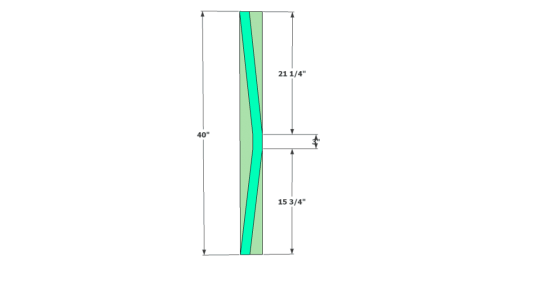
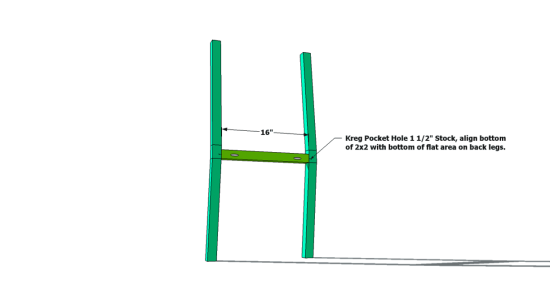
Cut your 2×4’s in the shape and dimensions indicated below. To begin, draw out the cut lines as you see them here, go slow, and be accurate. You will have the most success cutting this, with either a circular saw or jig saw. A jig saw can cut right along the lines you draw, whereas with a circular saw, you will need to stop at each change of direction and angle, and carve out the triangular piece you began with, before moving on in another direction. You want to be sure both legs match and that the bottom of the legs, and the 3” vertical center (where the seat will connect), line up as perfectly as possible. To ensure matching dimensions and angles, clamp the legs together after you cut them out, and sand the matching faces of both at the same time for all 4 sides. Once they are matching and sanded, connect them with the rail as indicated below. It will sit at the bottom of the 3” vertical space on the legs..
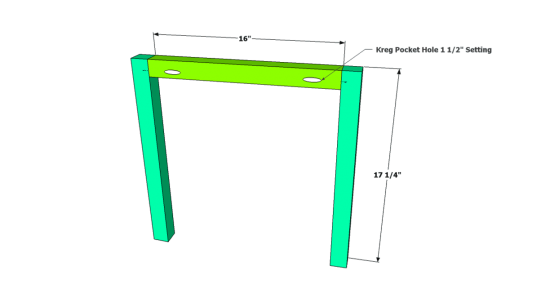
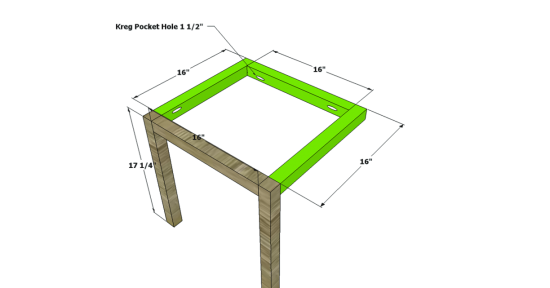
Build the front: cut all pieces to size, then place your pocket holes in the areas indicated below. Use your 1 1/2” setting and your 2 1/2” pocket hole screws.
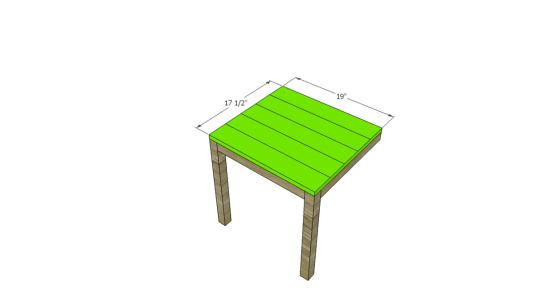
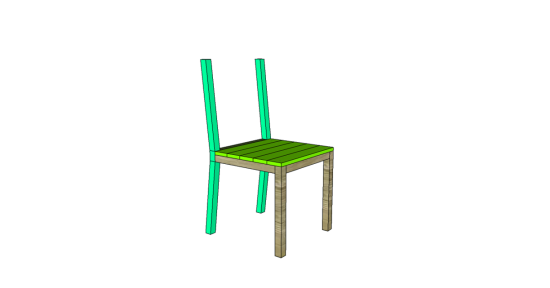
Fasten slats to the chair front from underneath, use glue and fasten up through the chair aprons, all the way around, to hide attachments. Then attach the chair front to the chair back. Use the back aprons to attach to the back legs, and secure from the inside. Tack on the last seat slat, your 1×2 seat slat, that should sit directly on top of the back apron between the back legs.
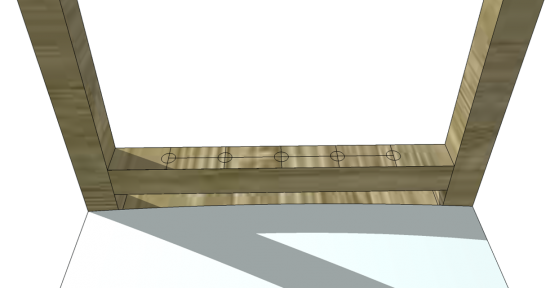
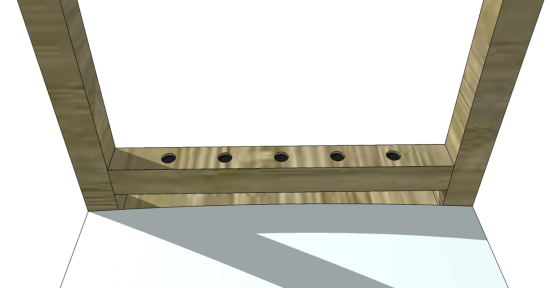
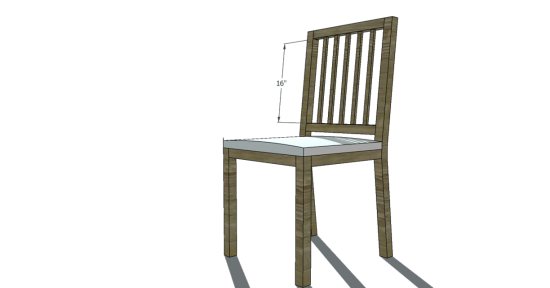
Cut your rails and slats to size, and note the slats are actually 1” longer than the dimension which will show. Create your pocket holes on the rails and drill your holes in both the top and bottom rails to house your slats. To create slat holes, mark out your drill hole locations by finding your middle, then dividing the remaining space in thirds. You should be placing the remaining holes approximately 2 2/3” apart. To create slat holes, use a 1/2” drill bit with a collar stop at 1/2”. This can be even a piece of masking tape marking the spot on your drill for 1/2”. This will keep you from drill farther than 1/2” into the rails. The slats are actually housed inside the rails by a 1/2” on the top and bottom and only need a bit of glue to be held in place, however if you prefer to also fasten with a pocket hole, you may. Once your holes have been drilled, secure the bottom rail in place (to the legs), drop in the slats with a drop of glue in each hole, then place a drop of glue in each hole for the top rail and turn over to set on top of the slats. Secure the top rail to the legs.
Fill any Screw, Nail or Pocket Holes, Sand and Finish as Desired. For Finishing Tips and Tricks visit my Finishing School
**Disclaimer: Some rights reserved. Private use only. Feel Free to link to any of my plans so long as you provide an adequate link back to the appropriate post! Plans from this page are not to be used for commercial purposes or republished without the express written consent of Rayan Turner, The Design Confidential I hope to provide accurate plans, however, I cannot guarantee each plan for accuracy. Not every plan that I post has been built and tested, so you are building at your own risk. It is recommended that you have a clear understanding of how the project works before beginning any project. Please contact me if you find an error or inaccuracy so that I might fix it. / Affiliate links are used for tools and materials. The Design Confidential will earn a small commission for any items purchased using these links. Thank you for your support – every little bit counts!

Hi, your plans seem to have gone missing for this dining chair.
I’m on it! Stay tuned