Plans

Project Image
Project Details

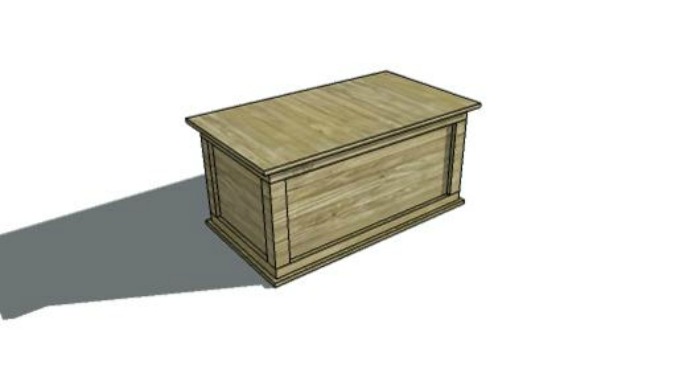
Free DIY Furniture Plans to Build a Pickford Cabinet, with two drawers and four cubbies with doors.

Estimated Cost

$50-$75

Dimensions
Dimensions for This Project
Tools
  • Tape Measure
  • Saw – Jig, Circular, or Miter
  • Drill
  • Router with a rabbeting bit to cut a 3/8” wide by ¼” deep rabbet
  • Square
  • Sander
  • Kreg Jig
  • Brad Nailer
  • Hammer
  • Wood Chisel
Lumber
  • 1 – 1x2 at 8’
  • 1 – 1x2 at 4’
  • 1 half sheet of ½” plywood
  • 1 full sheet of ¾” plywood
Materials
  • 1” pocket hole screws
  • 1-1/4” pocket hole screws
  • 1/2” brad nails
  • Edge banding
  • 4 sets of non-mortise hinges
  • 12 cabinet pulls
  • 2 door handles
  • Glass or acrylic cut to fit inside glass door frames
  • 4 bun feet at 3” tall plus plates for installation
  • Wood filler
  • Sandpaper
  • Wood glue
  • Finishing Supplies
Cut List
  • 2 – ¾”plywood at 13-3/4” x 31-1/2” – Top & Bottom
  • 2 – ¾” plywood at 12-1/4” x 48-1/2” – Sides
  • 1 – ¾”plywood at 11-1/2” x 48-1/2” – Divider
  • 4 – ¾” plywood at 11-1/2” x 13-7/8” – Shelves
  • 2 – ½” plywood at 10-1/4” x 12-5/8” – Drawer Bottoms
  • 4 – ½” plywood at 7-7/16” x 10-1/4” – Drawer Sides
  • 4 – ½” plywood at 7-7/16” x 13-5/8” – Drawer Front & Back
  • 12 – ¼” plywood at 6-3/4” x 7-7/16” – False Drawer Fronts
  • 2 – ½” plywood at 13-5/8” x 15-3/8” – Doors
  • 4 – 1x2 at 10-5/8” – Door Rails
  • 4 – 1x2 at 23-5/8” – Door Stiles
  • 2 – ½” plywood at 20-5/8” – Glass Door Divider
  • 8 – ½” plywood at 4-9/16” – Glass Door Divider
Instructions

Before beginning to build, always check in on my site to make sure you have the most up to date set of plans, I occasionally update and change the plans to make the building process easier or to allow for less expensive purchasing of materials! Read through the entire set of instructions and all comments before beginning this project. If you print out or save plans, be sure to check in on my site to be sure you have the most up to date set of plans, as I occasionally update things for ease of building or buying. If you are new to building, read through the GETTING STARTED section and other articles found under the BUILD tab in the menu on my site, it has valuable information about how to get started, tools and techniques. If you are unfamiliar with the finishing process, visit my Finishing school for some tips and tricks for painting like a pro and for special finishing practices. Use glue to secure your joints and Consider Painting or Staining individual sections prior to assembling. This makes the paint application virtually flawless. Coat with a spray on Poly or Wipe on Poly to protect your finish and your piece and it will last for ages. Adhere to all safety standards and guidelines, and be sure you follow safety protocol throughout your build. If you are unsure about whether you are building safely, run a quick online search for the tool or technique you are using, or contact me via email or post to the forum before you move ahead. My contact info can be found in the menu of my site.
Step 1

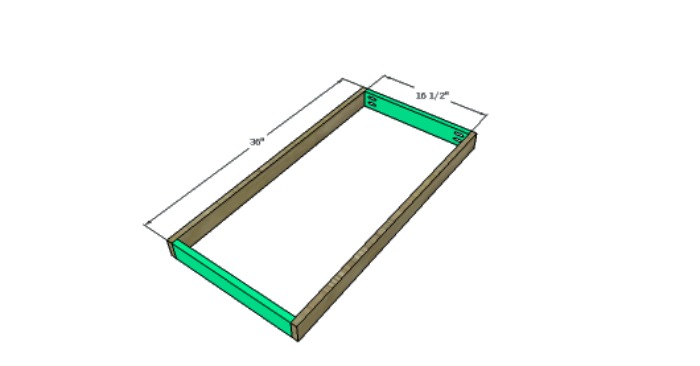
Edge banding will be applied to all exposed edges of plywood before assembly.

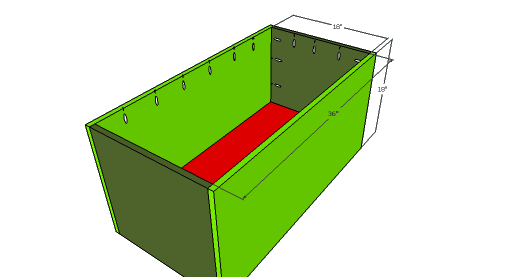
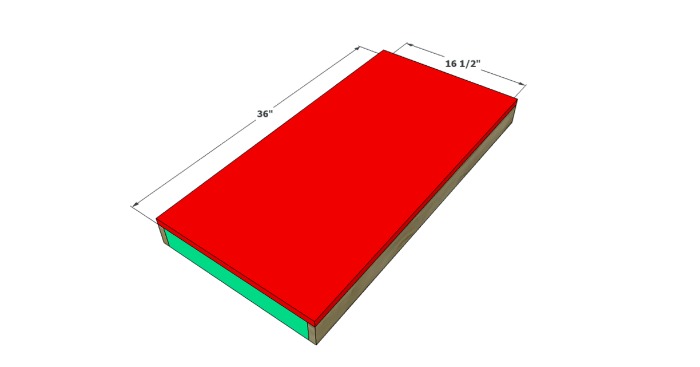
Cut the pieces for the bottom and the sides. Set the Kreg jig for ¾” material and drill pocket holes in each end of the sides. Position the sides on the bottom so that they are ¾” in from each side, and ¾” away from the front and back edges. Secure using glue and 1-1/4” pocket hole screws.

Step 1
Step 2

Cut the piece for the back and drill pocket holes in all four edges. Position the back between the side pieces so that the outside face is flush with the back edge of the sides. Secure to the sides using glue and 1-1/4” pocket hole screws.

Step 2
Step 3

Cut the piece for the divider and drill pocket holes in each end, as well as the back edge. Position as shown in the drawing then secure using glue and 1-1/4” pocket hole screws.

Step 3
Step 4

Cut the pieces for the shelves and drill pocket holes in each end, as well as the back edge. Position as shown in the drawing then secure using glue and 1-1/4” pocket hole screws.

Step 4
Step 5

Cut the piece for the top. Secure to the cabinet using glue and 1-1/4” pocket hole screws with ¾” overlapping on all sides.

Step 5
Step 6

Cut the pieces for the drawer boxes and the false drawer fronts. Set the Kreg jig for ½” material and drill pocket holes in all four edges of the bottom, as well as each end of the sides. Assemble the drawer as shown using glue and 1” pocket hole screws. Position the false drawer fronts as shown then secure using glue and ½” brad nails.

Step 6
Step 6
Step 7

Cut the pieces for the doors. The false drawer fronts will be positioned so they overhang the top and bottom of the door by about 1/16”. Secure using glue and ½” brad nails. Install the hinges according to the manufacturer’s instructions. 

Step 7
Step 7
Step 8

Cut the pieces for the glass door frames. Set the Kreg jig for ¾” material and drill pocket holes in each end of the ¾” rails locating the holes so that the router bit will not interfere with the screws. Secure the rails to the stiles using glue and 1-1/4” pocket hole screws. Using the router and the rabbeting bit, cut a rabbet on the inside of the frame for the glass. Use a hammer and a chisel to square the corners.

Cut the pieces for the dividers. Set the Kreg jig for ½” material and drill pocket holes in each end of the divider pieces. Secure the dividers to the frame so that the outside face is flush with the outside face of the frame (the glass will rest on top of the dividers) using glue and 1” pocket hole screws.

Install the hinges according to the manufacturer’s instructions. Secure the glass using a bead of silicone caulk on the inside of the rabbet.

Install all of the cabinet pulls and handles as desired.

Step 8
Step 8
Finishing Instructions

Fill any Screw, Nail or Pocket Holes, Sand and Finish as Desired. For Finishing Tips and Tricks visit my Finishing School

Disclaimer

**Disclaimer: Some rights reserved. Private use only. Feel Free to link to any of my plans so long as you provide an adequate link back to the appropriate post! Plans from this page are not to be used for commercial purposes or republished without the express written consent of Rayan Turner, The Design Confidential I hope to provide accurate plans, however, I cannot guarantee each plan for accuracy. Not every plan that I post has been built and tested, so you are building at your own risk. It is recommended that you have a clear understanding of how the project works before beginning any project. Please contact me if you find an error or inaccuracy so that I might fix it.

Project Image
Project Details

Free DIY Furniture Plans to Build an Original Office Collection Three Drawer Cabinet! The components in this collection can be mixed and matched. To see the other pieces we have published so far, click here or select Original Office Collection from the drop down menu on the plans page. Don't forget, you can also request plans by posting a link and or an image here. Don't be shy, we welcome your requests, questions and even cool building tricks you have learned. Join the community and chat it up! 

The length of the top will be cut separately, and depends on the number of components used with at least 24” for leg room if using as a desk. **

Estimated Cost

$25-$50

Dimensions
Dimensions for This Project
Tools
  • Tape Measure
  • Saw – Jig, Circular, or Miter
  • Drill
  • Brad nailer
  • Square
  • Sander
  • Kreg Jig 
Lumber
  • 1 sheet of ¾” plywood
Materials
  • 1-1/4” pocket hole screws
  • 1-1/4” brad nails
  • Edge banding for plywood
  • 3 sets of 18” drawer slides
  • Wood filler
  • Sandpaper
  • Wood glue
  • Finishing Supplies
Cut List
  • 2 – ¾” plywood at 20” x 27-1/4” – Sides
  • 3 – ¾” plywood at 1-1/2” x 16-1/8” – Upper Stretchers
  • 2 – ¾” plywood at 2-1/2”x 16-1/8” – Lower Stretchers
  • 1 – ¾” plywood at 16-1/8” x 20” – Bottom
  • 1 – ¾” plywood at 16-1/8” x 24” – Back
  • 1 – ¾” plywood at 17-5/8” x 20-3/4” – Top
  • 1 – ¾” plywood at 2-1/2” x 17-5/8” - Trim
  • 3 – ¾” plywood at 13-3/8” x 17-1/4” – Drawer Bottom
  • 2 – ¾”plywood at 4-9/16” x 17-1/4” – Small Drawer Sides
  • 1 – ¾” plywood at 4-9/16” x 14-7/8” – Small Drawer Back
  • 1 – ¾” plywood at 5-9/16” x 16-5/8” – Small Drawer Front
  • 2 – ¾” plywood at 10-3/8” x 17-1/4” – Large Drawer Sides
  • 1 – ¾” plywood at 10-3/8” x 14-7/8” – Large Drawer Back
  • 1 – ¾”plywood at 11-3/8” x 16-5/8” – Large Drawer Front
Instructions

Before beginning to build, always check in on my site to make sure you have the most up to date set of plans, I occasionally update and change the plans to make the building process easier or to allow for less expensive purchasing of materials! Read through the entire set of instructions and all comments before beginning this project. If you print out or save plans, be sure to check in on my site to be sure you have the most up to date set of plans, as I occasionally update things for ease of building or buying. If you are new to building, read through the GETTING STARTED section and other articles found under the BUILD tab in the menu on my site, it has valuable information about how to get started, tools and techniques. If you are unfamiliar with the finishing process, visit my Finishing school for some tips and tricks for painting like a pro and for special finishing practices. Use glue to secure your joints and Consider Painting or Staining individual sections prior to assembling. This makes the paint application virtually flawless. Coat with a spray on Poly or Wipe on Poly to protect your finish and your piece and it will last for ages. Adhere to all safety standards and guidelines, and be sure you follow safety protocol throughout your build. If you are unsure about whether you are building safely, run a quick online search for the tool or technique you are using, or contact me via email or post to the forum before you move ahead. My contact info can be found in the menu of my site.

Step 1

Edge banding will be applied to the exposed edges of the plywood before assembly.

Cut the pieces for the sides and the lower stretchers. Set the Kreg jig for ¾” material and drill pocket holes in each end of the stretcher pieces, as well as the top edge of the sides. Assemble as shown using glue and 1-1/4” pocket hole screws.

Step 1
Step 2

Cut the piece for the bottom and position as shown. Secure to the stretchers using glue and 1-1/4” brad nails.

Step 2
Step 3

Cut the piece for the back and drill pocket holes in all four edges. Position as shown and secure using glue and 1-1/4” pocket hole screws.

Step 3
Step 4

Cut the pieces for the upper stretchers and drill pocket holes in each end. Position as shown and secure using glue and 1-1/4” pocket hole screws.

Step 4
Step 5

Cut the piece for the top. The front will overlap by ¾”. Secure using glue and 1-1/4” pocket hole screws through the holes drilled in the back and side pieces.

Step 5
Step 6

Cut the piece for the trim. Secure in place using glue and 1-1/4” brad nails.

Step 6
Step 7

Cut the pieces for the drawers. Drill pocket holes in each end of the side pieces as well as all four edges of the bottom. Assemble as shown using glue and 1-1/4" pocket hole screws. The fronts will overlap the drawer opening by 3/8” on the sides, and ¼” at the top and bottom.

Install the drawer slides according to the manufacturer's instructions. For an easy tutorial, click here. Make any necessary adjustments. 

Step 7
Step 7
Step 7
Step 7
Step 7
Finishing Instructions

Fill any Screw, Nail or Pocket Holes, Sand and Finish as Desired. For Finishing Tips and Tricks visit my Finishing School

Disclaimer

**Disclaimer: Some rights reserved. Private use only. Feel Free to link to any of my plans so long as you provide an adequate link back to the appropriate post! Plans from this page are not to be used for commercial purposes or republished without the express written consent of Rayan Turner, The Design Confidential I hope to provide accurate plans, however, I cannot guarantee each plan for accuracy. Not every plan that I post has been built and tested, so you are building at your own risk. It is recommended that you have a clear understanding of how the project works before beginning any project. Please contact me if you find an error or inaccuracy so that I might fix it.

Project Image
Project Details

Free DIY Furniture Plans to Build a Piemonte 3-Drawer Dresser. I love the versatility this pieces has! I would use something like this as an end table, in an entry way, as an occasional table, it really might go anywhere... Xx... Rayan

Estimated Cost

$50-$75

Dimensions
Dimensions for This Project
Tools
  • Tape Measure
  • Saw – Jig, Circular, or Miter
  • Drill
  • Square
  • Sander
  • Kreg Jig
  • Brad Nailer
Lumber
  • 2 – 1x4 at 8’
  • 1 sheet of ¾” plywood
  • 1 – 4” wide trim at 8’
  • 2 – 1” wide trim at 8’
Materials
  • 1-1/4” pocket hole screws
  • 1-1/4” brad nails
  • Edge banding
  • 3 cabinet pulls
  • Wood filler
  • Sandpaper
  • Wood glue
  • Finishing Supplies
Cut List
  •  2 – ¾” plywood at 13” x 29” – Sides
  • 1 – ¾” plywood at 19-1/2” x 24-3/4” – Back
  • 4 – ¾” plywood at 12-1/4” x 19-1/2” – Shelves
  • 1 – ¾” plywood at 13-1/2” x 22” – Top
  • 3 – ¾” plywood at 10-1/2” x 17” – Drawer Bottoms
  • 6 – 1x4 at 10-1/2” – Drawer Sides
  • 6 – 1x4 at 18-1/2” – Drawer Fronts & Backs
  • 3 – ¾” plywood at 5-1/8” x 19-1/4” – Drawer Fronts
  • Drawer Trim – Cut to fit
  • Lower Trim – Cut to fit


Instructions

Before beginning to build, always check in on my site to make sure you have the most up to date set of plans, I occasionally update and change the plans to make the building process easier or to allow for less expensive purchasing of materials! Read through the entire set of instructions and all comments before beginning this project. If you print out or save plans, be sure to check in on my site to be sure you have the most up to date set of plans, as I occasionally update things for ease of building or buying. If you are new to building, read through the GETTING STARTED section and other articles found under the BUILD tab in the menu on my site, it has valuable information about how to get started, tools and techniques. If you are unfamiliar with the finishing process, visit my Finishing school for some tips and tricks for painting like a pro and for special finishing practices. Use glue to secure your joints and Consider Painting or Staining individual sections prior to assembling. This makes the paint application virtually flawless. Coat with a spray on Poly or Wipe on Poly to protect your finish and your piece and it will last for ages. Adhere to all safety standards and guidelines, and be sure you follow safety protocol throughout your build. If you are unsure about whether you are building safely, run a quick online search for the tool or technique you are using, or contact me via email or post to the forum before you move ahead. My contact info can be found in the menu of my site.

Step 1

Edge banding will be applied to the exposed edges of the plywood before assembly.

Cut the pieces for the sides. Set the Kreg jig for ¾” material and drill pocket holes in the top edge.

Cut the piece for the back and drill pocket holes in the sides and top. Secure the back to the sides as shown using glue and 1-1/4” pocket hole screws.

Step 1
Step 2

Cut the pieces for the shelves and drill pocket holes in each end as well as the back edge. Secure to the sides and back as shown using glue and 1-1/4” pocket hole screws.

Step 2
Step 3

Cut the piece for the top. Position the top so that ½” overhangs each side and the front, then secure with 1-1/4” pocket hole screws through the sides and back into the underside of the top.

Step 3
Step 4

Cut the pieces for the drawers. Drill pocket holes in each end of the side pieces as well as all four edges of the bottom. Assemble the drawer as shown using glue and 1-1/4” pocket hole screws. Cut the pieces for the drawer fronts and mark the position of the pulls. Drill the holes for the pulls all the way through the boards. For an easy tutorial on positioning drawer fronts, click here.

Step 4
Step 4
Step 4
Step 5

Cut the pieces for the drawer trim. The dimensions will depend on the type of trim selected and if mitered corners will be used. Measure the lengths and cut the pieces accordingly. Fasten to each of the drawer fronts using glue and 1-1/4” brad nails.

The pieces for the lower trim will be measured and attached in the same manner.

Step 5
Step 5
Finishing Instructions

Fill any Screw, Nail or Pocket Holes, Sand and Finish as Desired. For Finishing Tips and Tricks visit my Finishing School

Disclaimer

**Disclaimer: Some rights reserved. Private use only. Feel Free to link to any of my plans so long as you provide an adequate link back to the appropriate post! Plans from this page are not to be used for commercial purposes or republished without the express written consent of Rayan Turner, The Design Confidential I hope to provide accurate plans, however, I cannot guarantee each plan for accuracy. Not every plan that I post has been built and tested, so you are building at your own risk. It is recommended that you have a clear understanding of how the project works before beginning any project. Please contact me if you find an error or inaccuracy so that I might fix it.

Project Image
Project Details

Free DIY Furniture Plans to Build an Original Office Small Hutch! Easy to build and big on storage goodness... to see the other pieces in this huge and fabulous collection, click here!

Estimated Cost

$50-$75

Dimensions
Dimensions for This Project
Tools
  • Tape Measure
  • Saw – Jig, Circular, or Miter
  • Drill
  • Countersink Bit for Drill
  • Square
  • Sander
  • Kreg Jig
  • Brad nailer
Lumber
  • 2 – 1x2 at 8’
  • 1 full sheet of ¾” plywood
  • 1 half sheet of ¾” plywood
Materials
  • 1-1/4” pocket hole screws
  • 1-1/4” screws
  • 1-1/4” brad nails
  • Edge banding for the plywood edges, optional
  • Wood filler
  • Sandpaper
  • Wood glue
  • Finishing Supplies
Cut List
  •  2 – 1x2 at 11-1/4” – Feet
  • 2 – ¾” plywood at 11-1/4” x 43-1/2” – Sides
  • 1 – ¾” plywood at 11-1/4” x 44-1/2” - Bottom
  • 1 – ¾” plywood at 40-3/4” x 44-1/2” – Back
  • 1 – 1x2 at 44-1/2” – Stretcher
  • 2 – ¾” plywood at 10-1/2” x 44-1/2” – Shelves
  • 1 – ¾” plywood at 12-1/4” x 48” – Top
  • 2 – 1x2 at 11-1/4” – Side Trim
  • 1 – 1x2 at 47-1/2” – Front Trim
Instructions

Before beginning to build, always check in on my site to make sure you have the most up to date set of plans, I occasionally update and change the plans to make the building process easier or to allow for less expensive purchasing of materials! Read through the entire set of instructions and all comments before beginning this project. If you print out or save plans, be sure to check in on my site to be sure you have the most up to date set of plans, as I occasionally update things for ease of building or buying. If you are new to building, read through the GETTING STARTED section and other articles found under the BUILD tab in the menu on my site, it has valuable information about how to get started, tools and techniques. If you are unfamiliar with the finishing process, visit my Finishing school for some tips and tricks for painting like a pro and for special finishing practices. Use glue to secure your joints and Consider Painting or Staining individual sections prior to assembling. This makes the paint application virtually flawless. Coat with a spray on Poly or Wipe on Poly to protect your finish and your piece and it will last for ages. Adhere to all safety standards and guidelines, and be sure you follow safety protocol throughout your build. If you are unsure about whether you are building safely, run a quick online search for the tool or technique you are using, or contact me via email or post to the forum before you move ahead. My contact info can be found in the menu of my site.

Step 1

If using edge banding, it will be applied to the exposed edges of the plywood before assembly.

Cut the pieces for the sides and feet. Set the Kreg jig for ¾” material and drill pocket holes in the top edge of each side. Attach the feet to the bottom using glue and countersunk 1-1/4” screws. The side pieces will be positioned at the center of each foot.

Step 1
Step 2

Cut the piece for the bottom and drill pocket holes in each end. Position as shown then secure using glue and 1-1/4” pocket hole screws.

Step 2
Step 3

Cut the piece for the back and drill pocket holes in all four edges. Position as shown then secure using glue and 1-1/4” pocket hole screws.

Step 3
Step 4

Cut the pieces for the shelves and drill pocket holes in each end as well as one long edge. Position as shown then secure using glue and 1-1/4” pocket hole screws.

Step 4
Step 5

Cut the piece for the stretcher and drill pocket holes in each end. Position as shown then secure using glue and 1-1/4” pocket hole screws. The outside face of the stretcher will be flush with the outside edge of the sides.

Step 5
Step 6

Cut the piece for the top. The front and sides will overlap by 1”. Secure using glue and 1-1/4” pocket hole screws through the holes drilled in the sides and back.

Step 6
Step 7

Cut the pieces for the trim. Rout a decorative edge along one long edge of each piece if desired. Position the sides first and secure with glue and 1-1/4” brad nails, then attach the front in the same manner. A mitered corner will be used if routing a decorative edge. Adjust the length of the sides accordingly. Store-bought trim can also be used.

Step 7
Finishing Instructions

Fill any Screw, Nail or Pocket Holes, Sand and Finish as Desired. For Finishing Tips and Tricks visit my Finishing School

Disclaimer

**Disclaimer: Some rights reserved. Private use only. Feel Free to link to any of my plans so long as you provide an adequate link back to the appropriate post! Plans from this page are not to be used for commercial purposes or republished without the express written consent of Rayan Turner, The Design Confidential I hope to provide accurate plans, however, I cannot guarantee each plan for accuracy. Not every plan that I post has been built and tested, so you are building at your own risk. It is recommended that you have a clear understanding of how the project works before beginning any project. Please contact me if you find an error or inaccuracy so that I might fix it.

Project Image
Project Details

Free DIY Furniture Plans to Build a Reclaimed Timber Slat Coffee Table. This piece has a modern global sentiment and would be fabulous with many styles. Kinda love... Xx.. Rayan

Estimated Cost

$75-$100

Dimensions
Dimensions for This Project
Tools
  • Tape Measure
  • Saw – Jig, Circular, or Miter
  • Drill
  • Countersink Bit for Drill
  • Square
  • Sander
  • Brad Nailer
Lumber
  • 2 – 1x2 at 8’
  • 22 – 1x4 at 8’
  • It may be more economical to purchase 1x8 lumber and rip it down to the width needed or rip plywood into strips the proper width!
Materials
  • 1-1/4” screws OR
  • 1-1/4” brad nails
  • Wood filler
  • Sandpaper
  • Wood glue
  • Finishing Supplies
Cut List
  • 24 – 1x4 at 51” – Top
  • 46 – 1x2 at 3-1/2” – Top Spacers
  • 20 – 1x4 at 35-1/4” – Sides
  • 36 – 1x4 at 3-1/2” – Side Spacers
Instructions

Before beginning to build, always check in on my site to make sure you have the most up to date set of plans, I occasionally update and change the plans to make the building process easier or to allow for less expensive purchasing of materials! Read through the entire set of instructions and all comments before beginning this project. If you print out or save plans, be sure to check in on my site to be sure you have the most up to date set of plans, as I occasionally update things for ease of building or buying. If you are new to building, read through the GETTING STARTED section and other articles found under the BUILD tab in the menu on my site, it has valuable information about how to get started, tools and techniques. If you are unfamiliar with the finishing process, visit my Finishing school for some tips and tricks for painting like a pro and for special finishing practices. Use glue to secure your joints and Consider Painting or Staining individual sections prior to assembling. This makes the paint application virtually flawless. Coat with a spray on Poly or Wipe on Poly to protect your finish and your piece and it will last for ages. Adhere to all safety standards and guidelines, and be sure you follow safety protocol throughout your build. If you are unsure about whether you are building safely, run a quick online search for the tool or technique you are using, or contact me via email or post to the forum before you move ahead. My contact info can be found in the menu of my site.

Step 1

Notes:

It would be easiest to sand and stain each board before cutting it. The cut ends can always be touched up after cutting. The table will be assembled by starting with the top and layering each piece. Using brad nails would be better than screws because there will be less of a chance of hitting a nail in the piece below but screws can still be used, if desired (just keep that in mind!).

Cut the pieces for the top and the top spacers. Position the spacers on the first board locating them 2” in from each end. Secure using glue and 1-1/4” brad nails or 1-1/4” countersunk screws. Continue layering all of the pieces in this manner until the top is complete.

Step 1
Step 2

Cut the pieces for the sides and the side spacers. Start by positioning the first side piece at each end of the table top. Secure to each top board using glue and 1-1/4” brad nails or 1-1/4” countersunk screws.

Step 2
Step 3

Continue layering each side board and spacer, securing with glue and 1-1/4” brad nails or 1-1/4” countersunk screws.

Touch up the stain on the cut ends, if it hasn’t been done so previously, then seal the entire table using a spray sealer.

Step 3
Finishing Instructions

Fill any Screw, Nail or Pocket Holes, Sand and Finish as Desired. For Finishing Tips and Tricks visit my Finishing School

Disclaimer

**Disclaimer: Some rights reserved. Private use only. Feel Free to link to any of my plans so long as you provide an adequate link back to the appropriate post! Plans from this page are not to be used for commercial purposes or republished without the express written consent of Rayan Turner, The Design Confidential I hope to provide accurate plans, however, I cannot guarantee each plan for accuracy. Not every plan that I post has been built and tested, so you are building at your own risk. It is recommended that you have a clear understanding of how the project works before beginning any project. Please contact me if you find an error or inaccuracy so that I might fix it.

Project Image
Project Details

Free DIY Furniture Plans to Build an Original Office Collection Four Drawer Cabinet, in an easy to follow format with all the supplies you need listed! Yahoo. 

** The components can be mixed and matched. The length of the top will be cut separately, and depends on the number of components used with at least 24” for leg room if using as a desk. **

Estimated Cost

$25-$50

Dimensions
Dimensions for This Project
Tools
  • Tape Measure
  • Saw – Jig, Circular, or Miter
  • Drill
  • Brad nailer
  • Square
  • Sander
  • Kreg Jig 
Lumber
  • 1 sheet of ¾” plywood
Materials
  • 1-1/4” pocket hole screws
  • 1-1/4” brad nails
  • Edge banding for plywood
  • 4 sets of 18” drawer slides
  • Wood filler
  • Sandpaper
  • Wood glue
  • Finishing Supplies
Cut List
  • 2 – ¾” plywood at 20” x 27-1/4” – Sides
  • 4 – ¾” plywood at 1-1/2” x 16-1/8” – Upper Stretchers
  • 2 – ¾” plywood at 2-1/2”x 16-1/8” – Lower Stretchers
  • 1 – ¾” plywood at 16-1/8” x 20” – Bottom
  • 1 – ¾” plywood at 16-1/8” x 24” – Back
  • 1 – ¾” plywood at 17-5/8” x 20-3/4” – Top
  • 1 – ¾” plywood at 2-1/2” x 17-5/8” – Trim
  • 3 – ¾” plywood at 13-5/8” x 17-1/4” – Drawer Bottom
  • 8 – ¾”plywood at 4-9/16” x 17-1/4” – Small Drawer Sides
  • 4 – ¾” plywood at 4-9/16” x 14-7/8” – Small Drawer Back
  • 4 – ¾” plywood at 5-9/16” x 16-5/8” – Small Drawer Front
Instructions

Before beginning to build, always check in on my site to make sure you have the most up to date set of plans, I occasionally update and change the plans to make the building process easier or to allow for less expensive purchasing of materials! Read through the entire set of instructions and all comments before beginning this project. If you print out or save plans, be sure to check in on my site to be sure you have the most up to date set of plans, as I occasionally update things for ease of building or buying. If you are new to building, read through the GETTING STARTED section and other articles found under the BUILD tab in the menu on my site, it has valuable information about how to get started, tools and techniques. If you are unfamiliar with the finishing process, visit my Finishing school for some tips and tricks for painting like a pro and for special finishing practices. Use glue to secure your joints and Consider Painting or Staining individual sections prior to assembling. This makes the paint application virtually flawless. Coat with a spray on Poly or Wipe on Poly to protect your finish and your piece and it will last for ages. Adhere to all safety standards and guidelines, and be sure you follow safety protocol throughout your build. If you are unsure about whether you are building safely, run a quick online search for the tool or technique you are using, or contact me via email or post to the forum before you move ahead. My contact info can be found in the menu of my site.

Step 1


Edge banding will be applied to the exposed edges of the plywood before assembly.

 Cut the pieces for the sides and the lower stretchers. Set the Kreg jig for ¾” material and drill pocket holes in each end of the stretcher pieces, as well as the top edge of the sides. Assemble as shown using glue and 1-1/4” pocket hole screws.

Step 1
Step 2

Cut the piece for the bottom and position as shown. Secure to the stretchers using glue and 1-1/4” brad nails.

Step 2
Step 3

Cut the piece for the back and drill pocket holes in all four edges. Position as shown and secure using glue and 1-1/4” pocket hole screws.

Step 3
Step 4

Cut the pieces for the upper stretchers and drill pocket holes in each end. Position as shown and secure using glue and 1-1/4” pocket hole screws.

Step 4
Step 5

Cut the piece for the top. The front will overlap by ¾”. Secure using glue and 1-1/4” pocket hole screws through the holes drilled in the back and side pieces.

Step 5
Step 6

Cut the piece for the trim. Secure in place using glue and 1-1/4” brad nails.

Step 6
Step 7

Cut the pieces for the drawers. Drill pocket holes in each end of the side pieces as well as all four edges of the bottom. Assemble as shown using glue and 1-1/4" pocket hole screws. The fronts will overlap the drawer opening by 3/8” on the sides, and ¼” at the top and bottom.

Install the drawer slides according to the manufacturer's instructions. For an easy tutorial, click here. Make any necessary adjustments. 

Step 7
Step 7
Step 7
Finishing Instructions

Fill any Screw, Nail or Pocket Holes, Sand and Finish as Desired. For Finishing Tips and Tricks visit my Finishing School

Disclaimer

**Disclaimer: Some rights reserved. Private use only. Feel Free to link to any of my plans so long as you provide an adequate link back to the appropriate post! Plans from this page are not to be used for commercial purposes or republished without the express written consent of Rayan Turner, The Design Confidential I hope to provide accurate plans, however, I cannot guarantee each plan for accuracy. Not every plan that I post has been built and tested, so you are building at your own risk. It is recommended that you have a clear understanding of how the project works before beginning any project. Please contact me if you find an error or inaccuracy so that I might fix it.

Project Image
Project Details

Free DIY Furniture Plans to show you how to Make and Build a Reclaimed Timber Slat Media Stand. Easy to follow and fabulous for your budget, these plans will give you specialty retailer style for pennies on the dollar!

Estimated Cost

$100-$150

Dimensions
Dimensions for This Project
Tools
  • Tape Measure
  • Saw – Jig, Circular, or Miter
  • Drill
  • Countersink Bit for Drill
  • Square
  • Sander
  • Kreg Jig
  • Brad Nailer
Lumber
  • 2 – 1x2 at 8’
  • 19 – 1x4 at 8’
  • 1 sheet of ¾” plywood
  • It may be more economical to purchase 1x8 lumber and rip it down to the width needed or rip strips of plywood


Materials
  • 1-1/4” screws OR
  • 1-1/4” brad nails
  • 1-1/4” pocket hole screws
  • ½” diameter threaded rod at 3’ with 2 nuts
  • 2 threaded inserts for the threaded rod
  • Wood filler
  • Sandpaper
  • Wood glue
  • Finishing Supplies
Cut List
  • 15 – 1x4 at 55” – Top & Bottom Frame
  • 46 – 1x2 at 3-1/2” – Top & Door Spacers
  • 22 – 1x4 at 18-3/4” – Sides & Legs
  • 22– 1x4 at 3-1/2” – Side & Leg Spacers
  • 18 – 1x4 at 27-7/16” – Doors
  • 1 – ¾” plywood at 11-3/4” x 50” – Bottom
  • 1 – ¾” plywood at 14-1/4” x 48” – Back
Instructions

Before beginning to build, always check in on my site to make sure you have the most up to date set of plans, I occasionally update and change the plans to make the building process easier or to allow for less expensive purchasing of materials! Read through the entire set of instructions and all comments before beginning this project. If you print out or save plans, be sure to check in on my site to be sure you have the most up to date set of plans, as I occasionally update things for ease of building or buying. If you are new to building, read through the GETTING STARTED section and other articles found under the BUILD tab in the menu on my site, it has valuable information about how to get started, tools and techniques. If you are unfamiliar with the finishing process, visit my Finishing school for some tips and tricks for painting like a pro and for special finishing practices. Use glue to secure your joints and Consider Painting or Staining individual sections prior to assembling. This makes the paint application virtually flawless. Coat with a spray on Poly or Wipe on Poly to protect your finish and your piece and it will last for ages. Adhere to all safety standards and guidelines, and be sure you follow safety protocol throughout your build. If you are unsure about whether you are building safely, run a quick online search for the tool or technique you are using, or contact me via email or post to the forum before you move ahead. My contact info can be found in the menu of my site.

Step 1

Notes:

It would be easiest to sand and stain each board before cutting it. The cut ends can always be touched up after cutting. The stand will be assembled by starting with the top and layering each piece. Using brad nails would be better than screws because there will be less of a chance of hitting a nail in the piece below but screws can still be used, if desired (just keep that in mind!). Drill the holes in the pieces (where indicated) before assembly, also. The pieces for the doors should be coated with paste wax before assembly, especially at the end where it layers with the sides. This will enable the doors to slide smoothly when being opened and closed. The plywood pieces will be secured using pocket hole screws.

Cut the pieces for the top and the top spacers. Position the spacers on the first board locating them 2” in from each end. Secure using glue and 1-1/4” brad nails or 1-1/4” countersunk screws. Continue layering all of the pieces in this manner until the top is complete.

Step 1
Step 2

Cut the pieces for the sides and the side spacers. Drill a ½” hole in each piece at one end as shown in the drawing. The first piece on each side will have a larger hole for the threaded insert. Tap the insert in each of the two boards before layering the side pieces. The bottom two boards will have a countersunk hole large enough to accommodate the nuts. Start by positioning the first side piece at each end of the table top. Secure to each top board using glue and 1-1/4” brad nails or 1-1/4” countersunk screws.

Step 2
Step 3

Continue layering each side board and spacer, securing with glue and 1-1/4” brad nails or 1-1/4” countersunk screws.

Step 3
Step 4

Cut the pieces for the doors and drill a ½” hole as indicated in the drawing at one end of each board. Cut the pieces for the spacers and position as shown. Secure using glue and 1-1/4” brad nails or 1-1/4” countersunk screws. Continue layering the boards until the doors are assembled. Slide the free ends of each door between the free ends of each side and line up the holes. Insert the threaded rod through the holes and turn it into the threaded inserts. Adjust the length of the rod if necessary, then add the nuts. Tighten with a pair of needle-nose pliers or a standard (flat) screwdriver.

Step 4
Step 4
Step 5

Cut the pieces for the bottom and the bottom boards. Set the Kreg jig for ¾” material and drill pocket holes in each longer edge of the bottom piece. Attach the bottom boards to the sides of the plywood using lgue and 1-1/4” pocket hole screws. Position the bottom assembly as shown and secure using glue and brad nails or countersunk screws.

Step 5
Step 6

Cut the piece for the back and drill pocket holes in all four edges. Position as shown then secure using glue and 1-1/4” pocket hole screws.

Step 6
Step 7

Cut the pieces for the legs. Layer and secure them in the same manner as previously done.

Step 7
Finishing Instructions

Fill any Screw, Nail or Pocket Holes, Sand and Finish as Desired. For Finishing Tips and Tricks visit my Finishing School

Disclaimer

**Disclaimer: Some rights reserved. Private use only. Feel Free to link to any of my plans so long as you provide an adequate link back to the appropriate post! Plans from this page are not to be used for commercial purposes or republished without the express written consent of Rayan Turner, The Design Confidential I hope to provide accurate plans, however, I cannot guarantee each plan for accuracy. Not every plan that I post has been built and tested, so you are building at your own risk. It is recommended that you have a clear understanding of how the project works before beginning any project. Please contact me if you find an error or inaccuracy so that I might fix it.

Project Image
Project Details

Free DIY Furniture Plans to Build a Crate & Barrel Inspired Alcove Wall Shelf! This piece is both modern and interesting, a fabulous way to display your wares... yahoo. go forth and build! Xx... Rayan

Notes: Pieces #4, #5, #6, and #10 will be measured before they are cut!

Estimated Cost

Under $25

Dimensions
Dimensions for This Project
Tools
  • Tape Measure
  • Saw – Jig, Circular, or Miter
  • Drill
  • Square
  • Sander
  • Kreg Jig
  • Brad Nailer
Lumber
  • 3 - 1x6 at 8’
Materials
  • 1-1/4” pocket hole screws
  • Wood filler
  • Sandpaper
  • Wood glue
  • Finishing Supplies
Cut List
  • 2 at 28-1/2” – Frame
  • 2 at 30” – Frame
  • 1 at 17-3/4” – #1
  • 1 at 22-1/4” - #2
  • 1 – at 6-5/16” - #3
  • 2 at 9-1/8” - #4
  • 1 at 15-7/8” - #5
  • 2 at 11-7/8” - #6
  • 1 at 7” - #7
  • 1 at 11-3/4” - #8
  • 1 at 12-3/4” - #9
  • 1 at 5-1/2” - #10
Instructions

Before beginning to build, always check in on my site to make sure you have the most up to date set of plans, I occasionally update and change the plans to make the building process easier or to allow for less expensive purchasing of materials! Read through the entire set of instructions and all comments before beginning this project. If you print out or save plans, be sure to check in on my site to be sure you have the most up to date set of plans, as I occasionally update things for ease of building or buying. If you are new to building, read through the GETTING STARTED section and other articles found under the BUILD tab in the menu on my site, it has valuable information about how to get started, tools and techniques. If you are unfamiliar with the finishing process, visit my Finishing school for some tips and tricks for painting like a pro and for special finishing practices. Use glue to secure your joints and Consider Painting or Staining individual sections prior to assembling. This makes the paint application virtually flawless. Coat with a spray on Poly or Wipe on Poly to protect your finish and your piece and it will last for ages. Adhere to all safety standards and guidelines, and be sure you follow safety protocol throughout your build. If you are unsure about whether you are building safely, run a quick online search for the tool or technique you are using, or contact me via email or post to the forum before you move ahead. My contact info can be found in the menu of my site.

Step 1

Notes:  Each piece will be cut and assembled individually. Some pieces will have pocket hole screws at one end and some will have pocket hole screws at both ends.

Cut the pieces for the frame. Set the Kreg jig for ¾” material and drill pocket holes in each end of the shorter pieces. Assemble using glue and 1-1/4”pocket hole screws.

Step 1
Step 2

Cut the piece for #1 and drill pocket holes at each end. Position as shown and secure using glue and 1-1/4” pocket hole screws.

Step 2
Step 3

Cut the piece for #2 and drill pocket holes at each end. Position as shown and secure using glue and 1-1/4” pocket hole screws.

Step 3
Step 4

 Cut the piece for #3 and drill pocket holes at each end. Position as shown and secure using glue and 1-1/4” pocket hole screws.

Step 4
Step 5

 Measure then cut the pieces for #4 and drill pocket holes at each end. Position as shown and secure using glue and 1-1/4” pocket hole screws.

Step 5
Step 6

 Measure then cut the piece for #5 and drill pocket holes at each end. Position as shown and secure using glue and 1-1/4” pocket hole screws.

Step 6
Step 7

Measure then cut the pieces for #6 and drill pocket holes at each end. Position as shown and secure using glue and 1-1/4” pocket hole screws.

Step 7
Step 8

Cut the piece for #7 and drill pocket holes at one end. Position as shown and secure using glue and 1-1/4” pocket hole screws.

Step 8
Step 9

Cut the piece for #8 and drill pocket holes at each end. Position as shown and secure using glue and 1-1/4” pocket hole screws.

Step 9
Step 10
Cut the piece for #9 and drill pocket holes at one end. Position as shown and secure using glue and 1-1/4” pocket hole screws.
Step 10
Step 11

Measure then cut the piece for #10 and drill pocket holes at each end. Position as shown and secure using glue and 1-1/4” pocket hole screws.

Free DIY Furniture Plans to Build a Crate & Barrel Inspired Alcove Wall Shelf
Finishing Instructions

Fill any Screw, Nail or Pocket Holes, Sand and Finish as Desired. For Finishing Tips and Tricks visit my Finishing School

Disclaimer

**Disclaimer: Some rights reserved. Private use only. Feel Free to link to any of my plans so long as you provide an adequate link back to the appropriate post! Plans from this page are not to be used for commercial purposes or republished without the express written consent of Rayan Turner, The Design Confidential I hope to provide accurate plans, however, I cannot guarantee each plan for accuracy. Not every plan that I post has been built and tested, so you are building at your own risk. It is recommended that you have a clear understanding of how the project works before beginning any project. Please contact me if you find an error or inaccuracy so that I might fix it.

Project Image
Project Details

Free DIY Furniture Plans: How to Build a Crate and Barrel Inspired Village Black Armless Bench. Simple lines, beautiful features, this bench has it all... Xx.. Rayan

Estimated Cost

$25-$50

Dimensions
Dimensions for This Project
Tools
  • Tape Measure
  • Saw – Jig, Circular, or Miter
  • Drill
  • Countersink Bit for Drill
  • Square
  • Sander
  • Kreg Jig
  • Brad nailer
Lumber
  • 4 – 1x2 at 8’
  • 2 – 1x3 at 8’
  • 2 – 2x2 at 8’
  • 1 – 2’ x 4’ sheet of ¾” plywood
Materials
  • 1-1/4” pocket hole screws
  • 2-1/2” pocket hole screws
  • 1-1/4” brad nails
  • Edge banding for plywood
  • Wood filler
  • Sandpaper
  • Wood glue
  • Finishing Supplies
Cut List
  • 2 – 2x2 at 18” – Lower Back Legs
  • 2 – 2x2 at 18-1/2” – Upper Back Legs
  • 1 – 1x2 at 35-3/4” – Back Stretcher
  • 2 – 1x3 at 35-3/4” – Lower Back & Front Stretchers
  • 1 – 1x2 at 39-3/4” – Upper Back
  • 11 – 1x2 at 14” – Back Slats
  • 2 – 2x2 at 17-1/4” – Front Legs
  • 2 – 1x3 at 16-1/2” – Upper Side Stretchers
  • 2 – 1x3 at 17-1/2” – Seat Supports
  • 2 – 1x2 at approximately 17-3/16” – Lower Side Stretchers (Cut these pieces after the chair is assembled)
  • 1 – 1x2 at 36-3/4” – Lower Stretchers
  • 1 – ¾” plywood at 19-1/2” x 38-3/4” - Seat
Instructions

Before beginning to build, always check in on my site to make sure you have the most up to date set of plans, I occasionally update and change the plans to make the building process easier or to allow for less expensive purchasing of materials! Read through the entire set of instructions and all comments before beginning this project. If you print out or save plans, be sure to check in on my site to be sure you have the most up to date set of plans, as I occasionally update things for ease of building or buying. If you are new to building, read through the GETTING STARTED section and other articles found under the BUILD tab in the menu on my site, it has valuable information about how to get started, tools and techniques. If you are unfamiliar with the finishing process, visit my Finishing school for some tips and tricks for painting like a pro and for special finishing practices. Use glue to secure your joints and Consider Painting or Staining individual sections prior to assembling. This makes the paint application virtually flawless. Coat with a spray on Poly or Wipe on Poly to protect your finish and your piece and it will last for ages. Adhere to all safety standards and guidelines, and be sure you follow safety protocol throughout your build. If you are unsure about whether you are building safely, run a quick online search for the tool or technique you are using, or contact me via email or post to the forum before you move ahead. My contact info can be found in the menu of my site.

Step 1

Cut the pieces for the upper and lower back legs. Cut the tapers using a jigsaw or tapering jig on a table saw. Set the Kreg jig for 1-1/2” material and drill pocket holes in the top edge of the lower back legs. Note there will be a right and a left leg. Set the Kreg jig for ¾” material and drill pocket holes in the back edge of the upper legs. Assemble the legs as shown using glue and 2-1/2” pocket hole screws.

Step 1
Step 1
Step 2

Cut the pieces for the back stretchers and the upper back. Cut the angle in each end of the upper back noting that it is not a 45 degree angle. Drill pocket holes in each end of the back stretcher as well as the lower back stretcher. Position the 1x2 back stretcher as shown and secure to the upper back legs using glue and 1-1/4”pocket hole screws. The front face of the stretcher will be flush with the front face of the upper legs. Position the lower stretcher ¼” back from the outside edge of the legs and secure using glue and 1-1/4” pocket hole screws.

Cut the pieces for the slats and cut a 5 degree bevel in the top edge of each slat slanting toward the back. Drill pocket holes in each then secure as shown using glue and 1-1/4” pocket hole screws.

Step 2
Step 2
Step 3

Cut the pieces for the front legs and the front stretcher. Cut the tapers in the front legs in the same manner as the back legs. Drill pocket holes in each end of the stretcher then secure as shown using glue and 1-1/4” pocket hole screws.

Step 3
Step 4

Cut the pieces for the upper side stretchers and drill pocket holes in each end. Secure to the front and back legs as shown using glue and 1-1/4” pocket hole screws. Position the stretchers ¼” back from the outside edge of the legs.

Cut the pieces for the seat supports and drill pocket holes in each end. Secure to the stretchers as shown using glue and 1-1/4” pocket hole screws.

Step 4
Step 4
Step 5

Cut the pieces for the lower stretchers. The length and angle of the side stretchers will depend on the angle of the legs as well as the measurement between them. Clamp a 1x2 piece to the legs at the position of the lower stretcher and draw a line along the angles. Cut with the saw of your choice, then drill pocket holes in each end. Position the stretchers so they are located ¼” back from the outside face then secure using glue and 1-1/4” pocket hole screws.

Cut the piece for the center lower stretcher and drill pocket holes at each end. Position it in the center of the lower side stretchers then secure using glue and 1-1/4” pocket hole screws.

Step 5
Step 5
Step 6

Cut the piece for the seat and cut the notches using a jigsaw. Apply the edge banding, if desired. Position the seat on the frame and secure using glue and 1-1/4” brad nails.

Step 6
Step 6
Finishing Instructions

Fill any Screw, Nail or Pocket Holes, Sand and Finish as Desired. For Finishing Tips and Tricks visit my Finishing School

Disclaimer

**Disclaimer: Some rights reserved. Private use only. Feel Free to link to any of my plans so long as you provide an adequate link back to the appropriate post! Plans from this page are not to be used for commercial purposes or republished without the express written consent of Rayan Turner, The Design Confidential I hope to provide accurate plans, however, I cannot guarantee each plan for accuracy. Not every plan that I post has been built and tested, so you are building at your own risk. It is recommended that you have a clear understanding of how the project works before beginning any project. Please contact me if you find an error or inaccuracy so that I might fix it.

Project Image

This project was hard. The End. But this portion I am sharing with you today, was not hard. This version is simple and you can finish this project in a day which will be mainly dry time. It turned out so fabulously that I am fairly certain I will repeat it a few more times! Next time it will be so much easier to do, since I feel like I truly figured out the process this go around, and perfected it. Now you guys can do this too and can skip the 17 versions I completed that didn't work, not even a little bit... yay for that!

painter's tape, scotchblue painter's tape, tape

This project is part of an amazing blog hop brought to you by ScotchBlue™ Painter's Tape and The Home Depot, you can find that fabulousness here at Ready, Set, Paint Blog Hop, and more info at the bottom of this post, yahoo... and also we have a GIVEAWAY! Yay! One of you fabulous friends will walk away with a $75 The Home Depot Gift Card! Woot Woot.. Let's get this party started with a little DIY fun! Then on to the giveaway and bloggity hop!

Materials:

  • ScotchBlue™ Painter's Tape
  • Concrete Resurfacer 
  • Universal Mixer Attachment for your Drill
  • Bucket
  • Masonry Brush
  • Trowel 
  • 12" Concrete Tube Form at 48"
  • Paint in a color of your choice
  • Water Seal (optional)
  • Jig Saw or Circular Saw
  • Large Drill Bit
  • 3/4" plywood at 24"x24"
  • 3/4" self tapping screws

I taped off my concrete tube form using ScotchBlue™ Painter's Tape at the 20" mark, from either end, so that I would have an easy to see guide for my table height. Then using a large drill bit, I drill pilot holes close to my tape lines so that I could start my jig saw with ease. Simply cut around the tape line on both sides to cut your form to size using a jig saw (easiest for me) or a circular saw if you prefer.

I traced around the inside of my concrete tube form to set my table top size appropriately, and then cut them out using my jig saw. 

I used self tapping screws to attach my top to the form sitting just inside the lip of the form. 

Mix your concrete resurfacer with water according to the instructions on the package. Use your handy dandy mixer attachment on a very low and slow speed to mix your material. You want to end up with a consistency that is something like really thick pancake batter for this to work how it should.


Use your Masonry Brush and paint on a thin layer of the concrete resurfacer. Once you have covered the base, use your trowel to cover the top (this is much easier than trying to use the brush for the top for some reason) and smooth a bit. 

Allow it to dry partially (about 70%) then sand smooth. Be careful not to sand off your thin layer of concrete. If you need to touch up, this is the time to do so while your material is still wet enough. If you want to add a thick layer of concrete, do this in steps with thin layers each time, and work your way up. If you layer too soon you will have that experience of accidentally wiping off your first layer as you attempt to add on to it. 

Allow your tables to completely cure for 24 hours or the recommended time on the package. Once dry you are ready to tape and paint! 

Be sure to choose a paint color with a bit of a sheen to help seal any unfinished edges on the tube form. This will also help the tables weather a bit better. Give the edges and the bottom inch of the underside a very good coat or two of your paint. 

I used a foam brush, since they grab quite a bit of paint, and used a stippling motion (pouncing) since the tables have quite a bit of texture. I worked my way around making sure to hit every single nook and cranny. I only did one coat, but I did a very good thick single coat. 

I like to remove my tape right away but this is a personal preference and not a requirement! For me it helps to know if I have made an error before I put my painting supplies away, so I 'check' my work early...

I would recommend a water seal spray of some sort if you live in a wet climate, just to be sure you don't have exposed cardboard around the bottom. Otherwise enjoy! 

Love, love, love these beauties and they are very light weight too! Easy to pick up and move around but sturdy enough for outdoor use! Though I'm thinking indoor use would be fabulous too. 

See another project from this blog-hop here: Centsational Girl - Textured Panel Dresser Makeover


Now who is ready for that giveaway I promised? You? Awesome! Enter using the form below!

a Rafflecopter giveaway

painter's tape, scotchblue painter's tape, tapepainter's tape, scotchblue painter's tape, tape

This post was brought to you in partnership with The Home Depot and ScotchBlue™ Painter's Tape.

Syndicate content